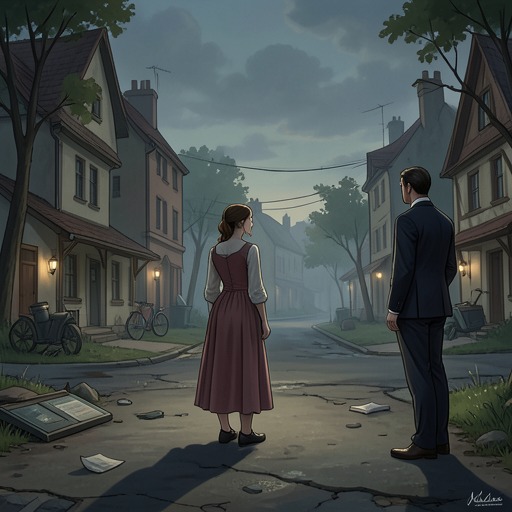
Dom as a ghostly third presence
Our Chemical HeartsDom as a ghostly third presence is the novel’s way of making bereavement an active force in Grace Town and Henry Page’s developing relationship. Dom is not literally present; he persists through the places and objects associated with him, through Henry’s belated understanding of Grace’s grief, and through the limits both teenagers place on their intimacy. The motif first makes their relationship feel crowded by the past, then shifts as Grace lets go of keepsakes and begins to live more fully in the present.
Memory, place, and the past
Grace’s sense of the universe offers an early frame for understanding how she lives with loss. Looking at the stars with Henry, she describes human life as the outcome of chance and science rather than magic. She returns to this place, which a friend first brought her to when they were children, to recall her smallness in the scale of the universe; she also regards space as a way to ease sadness. The passage does not identify that childhood friend as Dom, so the place establishes Grace’s outlook rather than serving as definite evidence of a shared location with him. Its importance lies in the contrast it introduces: human attachments matter deeply to the people who form them, even in a universe Grace sees as indifferent.
Dom’s presence becomes explicit when Grace tells Henry that Dom was driving during the crash, that she injured her leg, and that Dom died. The disclosure reorganizes details Henry had encountered without understanding: the graveyard, Grace’s clothes and car, the track, the abandoned train station, and the music of The Strokes. He realizes that a song he had treated as part of his growing connection with Grace belonged to her earlier relationship with Dom. The same music therefore carries two histories at once, and Henry’s new knowledge makes their emerging intimacy feel inseparable from a relationship that ended in loss.
A relationship with a third presence
Henry understands that he and Grace are not established partners: they have kissed, but she has asked him to keep their connection private until she knows what she wants. She is conscious that beginning another relationship so soon after Dom’s death may be judged as poor taste. Henry tries to respect this condition, even as it leaves him uncertain about his place in her life. His reluctance to ask about Dom also reflects his attachment to the version of Grace he has constructed: he has fallen for someone he experiences as mysterious, and part of him would rather not learn how much of her story precedes him.
After a film date, Henry leaves without knowing whether the evening has moved them closer. On the bus, he imagines Dom occupying the empty seat across from him, a figurative presence that expresses Henry’s discomfort and self-consciousness rather than a supernatural event. He recognizes that this will not be a simple romance, because Dom’s absence will remain part of their shared situation. Yet Henry also allows for change: Grace might get better, and he sometimes sees glimpses of the person she was before the loss. The tension is not simply between a living and a dead rival. It is between Henry’s hope for a future with Grace and his recognition that her attachment to Dom cannot be displaced by his feelings.
Objects that preserve a life
Henry’s understanding deepens when he enters Dom’s bedroom. Its ordinary teenage clutter—a bookcase, guitar, records, globe, skateboard, schoolwork, sports magazines, and childhood trophies—presents Dom as a particular person whose life cannot be reduced to his death. His jewelry remains on the dresser, among other belongings, and Henry recognizes that he and Dom used the same scent. The room makes the scale of Grace’s continuing attachment visible through the everyday things she has kept intact.
A shirt Grace wore to the movies sharpens that recognition. She had treated a ketchup mark but had not washed the garment, and Henry realizes that Dom’s clothes and sheets have remained unwashed as well. What he had taken for a personal quirk or carelessness now appears connected to her life in Dom’s room and to her continuing proximity to his belongings. The shirt links Grace, Dom, and Henry in one object, but it also reveals an imbalance: Henry has entered a relationship whose emotional history he did not know. In the novel’s ghostly image, Grace is not merely haunted by Dom; she is still living among the material traces of their life together.
Release without erasure
At the abandoned train station, Grace eventually brings a small metal box containing objects from Dom’s shrine: the anchor necklace she had worn when Henry first saw her, a The Strokes keychain, and Dom’s Ramones T-shirt. She and Henry enter the water holding hands, and Grace releases the keepsakes one by one. The box, marked with Dom’s name and grade, is the last item to sink. The action makes letting go concrete, but it does not establish that Grace has forgotten Dom or ceased to love him. Henry wonders whether the act resembles redemption and whether she has forgiven herself; the uncertainty matters, since release is presented as a possibility rather than proof of completed recovery.
After Christmas, Grace’s limp becomes less noticeable and she stops using her cane. She begins driving to school and sometimes wears an item of Dom’s clothing, but mostly returns to wearing her own. The change gives the motif a gradual, physical measure: Dom’s belongings do not disappear from her life all at once, yet they no longer define her daily presentation. The narration connects this shift to Grace working off an imagined debt and allowing herself to be redeemed, making self-punishment part of the ghostly presence’s hold over her.
Grace and Henry later sever their social-media connections and give their shared fish to Ryan, while the ties between them gradually loosen. Their separation does not resolve the different attachments that shaped the relationship: Henry continues to love Grace, and Grace continues to love Dom. The ending therefore complicates any equation of recovery with forgetting or of a new romance with replacement. Dom’s presence becomes less governing as Grace reclaims her habits and belongings, but the love and memory that remain are part of the life she carries forward.